Today, in the Northern Hemisphere, is the Winter Solstice. Today is the shortest day and longest night of the year. As such, our skin has progressively been exposed to less sun since the summer solstice (June 20th). Without ultraviolet B light exposure, our skin slows the production of Vitamin D3. Common symptoms of Vitamin D deficiency include fatigue, mood changes (seasonal affective disorder, etc.), muscle cramps, and joint pain. Long periods of vitamin D deficiency can lead to bone thinning.
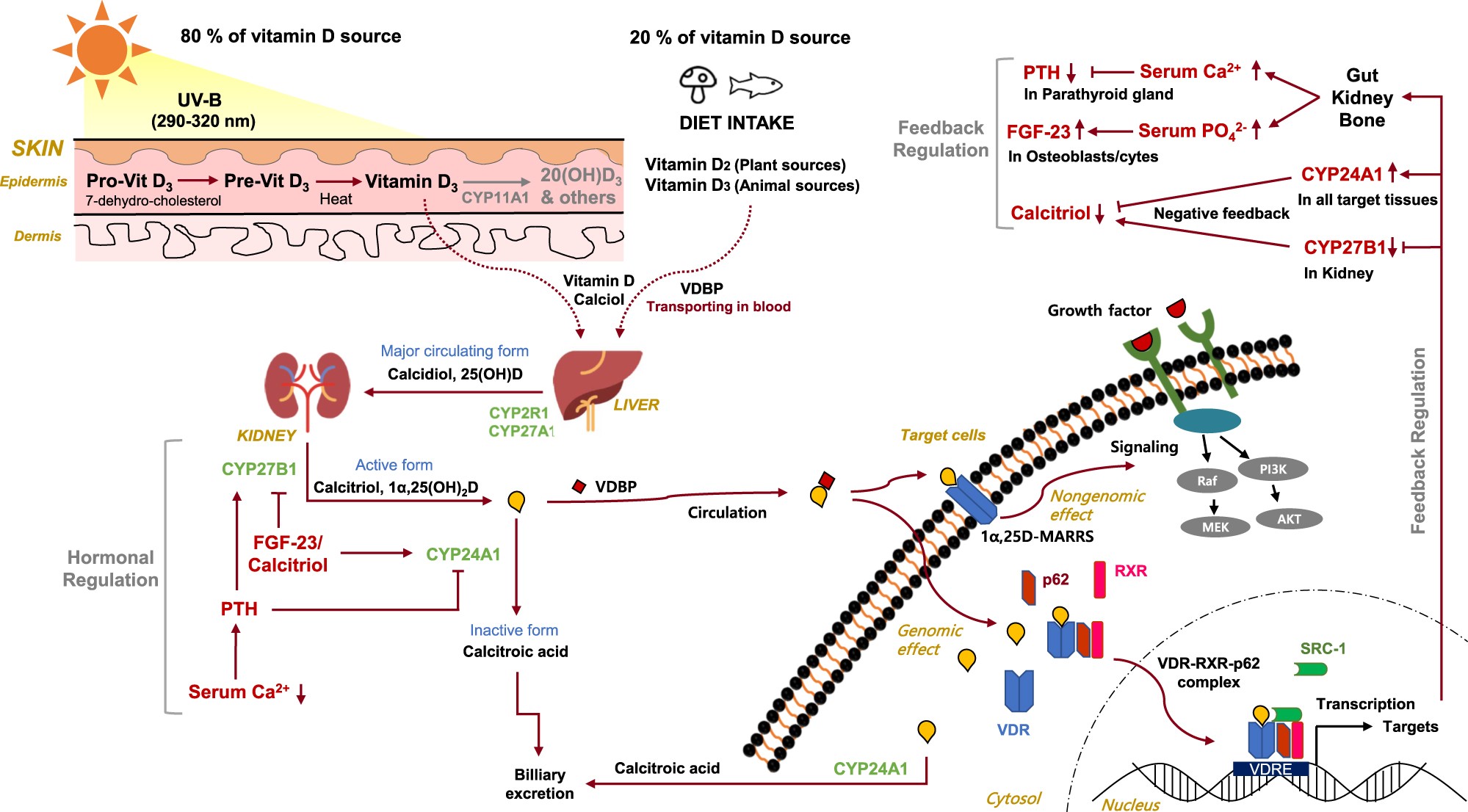
As the image above demonstrates, Vitamin D is involved in a lot of processes in the body. The interplay of parathyroid hormone, vitamin D, Phosphate, and Calcium regulates uptake from the kidney, liver, and gut as well as the metabolism at the level of the bone. Given the importance of magnesium on calcium and phosphate levels, magnesium is important to this balance as well. Vitamin D is derived from cholesterol and is quite fat-soluble. Low vitamin D can result from a variety of factors besides low UV-B exposure. Insufficient cholesterol (low intake, low production, or high excretion), dilution (high bodily fat requires more vitamin D to fill that volume), decreased UV-B absorption (dark skin protects against skin cancer and vitamin D production), or dysfunctional metabolic pathways (skin, kidney, liver, parathyroid, and bone) can all result in low vitamin D levels.
As science advances, this diagram will likely be incomplete and obsolete. Recent findings through artificial intelligence applications have identified many structures within a cell that were previously unidentified. We have so much to learn.

With Vitamin D, we continue to find the downstream effects of low circulating Vitamin D levels, measured through 25-OH Vitamin D (25-hydroxycholecalciferol) but not 1,25-OH Vitamin D. Some of the more interesting implications of low vitamin D include increased COPD Exacerbations and poorer outcomes in COVID-19 patients in the ICU. Oral supplementation of Vitamin D3 (calcitriol, ergocalciferol, etc.) can help restore circulating levels, but it is not clear if this is equivalent to natural production.
As with many things in medicine, causation is difficult to ascertain. Are we treating the underlying cause or a symptom of a larger problem when we increase our Vitamin D3 intake? Some of the serologic markers improve with a pill, but taking a pill for the rest of your life is not a cure.
Even if I spent the entire day outside naked, I would have less than 9 hours of exposure at a lower intensity than in the summer. It is unclear how much, or the intensity of, sunlight is needed to meet our Vitamin D requirements. This is likely variable based on the variables discussed above. Currently, the best estimate is 10-30 minutes of the mid-day sun. A personal strategy of mine is to get a 30-minute walk at lunch or to eat a healthy lunch outside. It is easiest to do this when it is not burning hot in the summer or frigid in the winter.
Life is a balance of risks and benefits. We all make mistakes along the way and no one makes it out alive. Skin cancer is always on my mind as I walk outside at lunch. I always wonder if it would be better to live with depression, osteoporosis, fatigue, and muscle aches or if it would be better to have skin cancer. Those suffering from any of those conditions would likely point to another condition and say that they would prefer the alternative. My family has a history of depression and osteoporosis, no one has had skin cancer. An individualized approach is sometimes the most difficult as it takes the liability off of the guidelines and places it on the person making the choice.
Nonetheless, enjoy your Winter Solstice, Yule in pagan tradition, or Christmas in Christianity. Stay healthy and take care of each other.
 Revolutionary Healthcare PLLC